E-mail Direct

Tel: 01379 870759

Deliveries for the winter 2012-2013 season have now been completed. We will be taking orders for next season from
1 June 2013, with deliveries starting from November 2013. Thank you!

Visit our Blog....


Fruit Trees for Sale - Apple | Pear | Plum | Quince | Cherry | Apricot | Peach | Nectarine and Expert Fruit Tree Growing Advice

Fruit trees for sale - apple, pear, plum, quince, cherry, apricot, peach & nectarine (and sweet chestnut, walnut, crab apple, cob nut, medlars, black mulberry, quinces and more...)

We specialize in the growing and supply of quality fruit trees, from a single apple, pear or other fruit tree for your patio, to a multi-fruit garden, a small orchard or an estate. We supply from an extensive list of varieties, and we can provide trees at the age and maturity that you prefer. We deliver throughout the UK.

The trees that we supply come with an important extra: our legendary support and expert advice. Our aim is to ensure that your trees thrive and provide you with fruit as soon as possible, and for years to come. Our advice begins with ensuring that your choice of trees from our extensive selection will work well, whether they are for a patio pot, garden or orchard. Following your purchase, our after-sales service provides assistance and tips on planting, getting the trees to grow well and crop as soon as possible, and personalized advice on what to do if unexpected difficulties arise. Every tree pack is accompanied by written summary instructions and recommendations, and we are always on hand for extra help.. Follow this link to read some customer comments on our service.

In other words, even though our trees are competitively priced, we are not just a mail-order tree supplier. By buying our trees, you are also buying our experience. All those who have purchased our trees are well aware that help is just a phone call – or an email message – away. It is this personal service, free of charge with your order, that sets us apart from the rest.

The trees we sell are not 'mail order matchsticks.' Most of our trees are well-developed specimens with useful side branches to encourage early cropping. This is why, with our trees, cropping usually begins the year after planting. The fact that our trees are sturdy, strong and healthy means that there are good levels of reserves in the tree structure. This helps them to resist diseases caused by the fungal spores that are always present in the air.

We would like to underline that fruit trees do best when they are planted in the period when they are fully dormant. This is in the period December to April. The best time to organize your planting plan is now. Once you have decided which trees you would like to plant (you can choose from our tree varieties page), please let us know and we can book those trees under your name. If you order in advance, the cost of the trees will be the same as the previous season. For example, £89 for an orchard pack consisting of 5 trees of your choice. To this, the cost of package and postage will have to be added . This will be made known to you once we know your full address and postcode.

For more information on fruit tree sales, please e-mail us your requirements and we can help you with your choice of trees, their age and variety. If you already know the sort of trees you are looking for, take a look at our tree varieties page, where you can make a selection and place a provisional order. We are always available to provide you with free advice on which tree combinations work best. We take pride in our service of offering orchard packs tailor-made to requirements. After all, everyone has a different garden, and their own favourite fruits!

We would like to provide three tips that are so important that we prefer to mention them right here on our home page. Firstly, any newly-planted tree should have a rabbit guard to protect the trunk from damage caused by hares and rabbits, but also by cats and dogs. The type of guard depends on the wildlife you have in your area. Secondly, the very best way to ensure that the trees get a really good start is to give each tree one or two full watering cans each week, right through the growing season, in other words from April to mid-September.

Our third suggestion regards wild flower meadows and their function in improving fruit tree cropping. We planted our own wild flower meadow 12 years ago, and we have seen how marvellous it is in providing a home for pollinating insects, above all in years of extreme climatic conditions. Just click here to find out more.

We hope that you enjoy our website, and we look forward to hearing from you. You can find more hints and tips on our blog!

Special offer: Standard Orchard Pack

Our Standard Orchard pack contains five trees, 2 apple trees, 1 pear, 1 plum, and 1 greengage or cherry tree, selected to ensure efficient pollination. (If you would prefer different types of trees in your Orchard Pack, you can simply specify your requirements. There is no extra cost for Orchard Pack personalization). These quality trees will usually begin cropping the year after planting. Price just £89 plus delivery.

We deliver trees to all addresses in the UK. Please remember that the sooner you order, the sooner you will receive your trees. The main delivery period is from December to March, when trees are dormant and so in the best possible condition for transplanting with a high success rate.

Click here for further details


New! Multi-fruit orchard service.

Ideal for a new orchard of at least 15 trees. Discover the pleasure of home-grown fruit – and beautiful blossom! Special offer now available for orders of 2, 3 or 4 Orchard Packs! Click here for details!

Click here for further details on our Multi-fruit orchard service


New! Suffolk Fruit & Trees Gift Vouchers.

Would you like to give someone a tree, or some trees, without the bother of having to choose and deliver them? Easy! With our Gift Voucher system, you just have to tell us how much you would like to spend, and we will inform you how many trees that represents, inclusive of delivery to your friend's or relation's home, wherever in the UK. After receiving your payment by cheque, we will send the voucher to the address required. The trees will be delivered in December-January, because that is the very best time to transplant trees, in their period of complete dormancy. We will of course let the recipient know when the trees are ready for dispatch. The trees will be accompanied by information on everything necessary for ensuring a healthy and productive life in the garden.
For further details, please contact us by email.


Top Ten Tips on caring for fruit trees
The fundamental thing to remember is that even though trees don’t talk or run around, they are living organisms and highly responsive to human beings. Regular visits to the trees are important, not least because in this way one can develop an understanding about the tree’s needs and behavior. One can then respond in the right manner to achieve good results in terms of growth and fertility. Trees that are well looked after will live much longer than us! Try to understand the tree’s needs by frequent visits, and all will be well.


Top Ten Tips
1) Do not plant an oldish or so-called “mature” tree, as you may be starting off with lots of problems. Plant a healthy 2 to 3-year old tree, and cropping will start the year after planting in the case of apples, peaches and apricots. Pears, plums and cherries will take another one or two years to start cropping.
2) Fruit trees are like youngsters; give them room to stretch out and grow, when they are young. Cropping will follow sooner then you think.
3) Make sure the trees have full light. That’s their source of energy. Shade always reduces cropping.
4) The soil has to be the best. The soil is the tree’s home. A tree likes its soil to be well aerated and full of nutrients.
5) Make sure that the soil and subsoil are never waterlogged, particularly in winter. Stagnant water is a death sentence for a fruit tree.
6) From April to September, water weekly, when the trees are young. 10 to 15 litres per week is a minimum. More in hot periods.
7) During the growing season, take note of the leaves. If they are deep green, the tree is happy. If they are a different colour, the tree is telling you something and needs your help.
8) Only transplant trees from December to March. This is the period of dormancy.
9) Keep one square metre of soil around the trunk totally free from grass and weeds. This solves many fruit growing problems.
10) When you think that picking time is near, taste the fruit. If you like the flavour, pick the fruit gently, without bruising it, and store it in a cool dark place at a temperature as close to 3° Celsius as possible. A second-hand fridge is ideal for storing all fruits.

Fruit tree growing advice
At last, fruit growing advice is just a click away. We provide expert help with fruit trees - for patios, gardens and small orchards - covering themes that include planning, planting, problem solving, orchard renovation, and biological fruit growing.

The whys and wherefores of fruit trees: the Realenglishfruit blog

In my experience, most people have their car serviced twice a year. The average life time of a car is no more than 7 years. A fruit tree has an average life of 28 years. That is 4 times as long. And yet many people plant a tree and then forget about servicing the poor tree! By that I mean a fruit tree also needs to be serviced at least twice a year. Just the same as your car.
But then most people say, “Well what am I supposed to do?" I hope that the topic of fruit tree care and the elementary principles on which fruit tree care should be based will become clearer on the RealEnglishFruit blog as time goes by. I will regularly update the whys and wherefores via this blog .This will particularly apply to trees grown in Northern Europe. Warmer climates changes things for trees substantially, and several other points need to be taken in consideration. All in all, fruit trees are very responsive to the care and attention given. The result will be regular crops of reasonable quality, without having to resort to genetic manipulation or extensive use of chemicals.

Visit our blog for regular, updated, seasonal advice on tree care. If you wish, you can also sign up so that you receive updates directly in your e-mailbox! Just click here to see the blog: http://www.realenglishfruit.com

Other aspects of our services

Design and planning of mini orchards and multi-fruit gardens
Fruit trees and the English landscape
Areas covered by our fruit tree supply and consultancy service
Real English Fruit: the background
Useful links
New! Espalier and Fan training: trees, information and tips


Design and planning of mini orchards and multi-fruit gardens
A number of fruit trees in a garden can become a very attractive feature as well as producing fruit. We can also provide advice on the use of ornamental trees in combination with the orchard area. There are several questions that should be considered in a small orchard. Pollination, which is essential for regular cropping. The size of the mature tree: varieties and rootstocks have to be chosen so that the trees do not block the light from areas of your garden. Shelter: particularly liked by some trees. Rootstock: as well as affecting size, the rootstock determines the size of the fruit and the regularity of cropping.

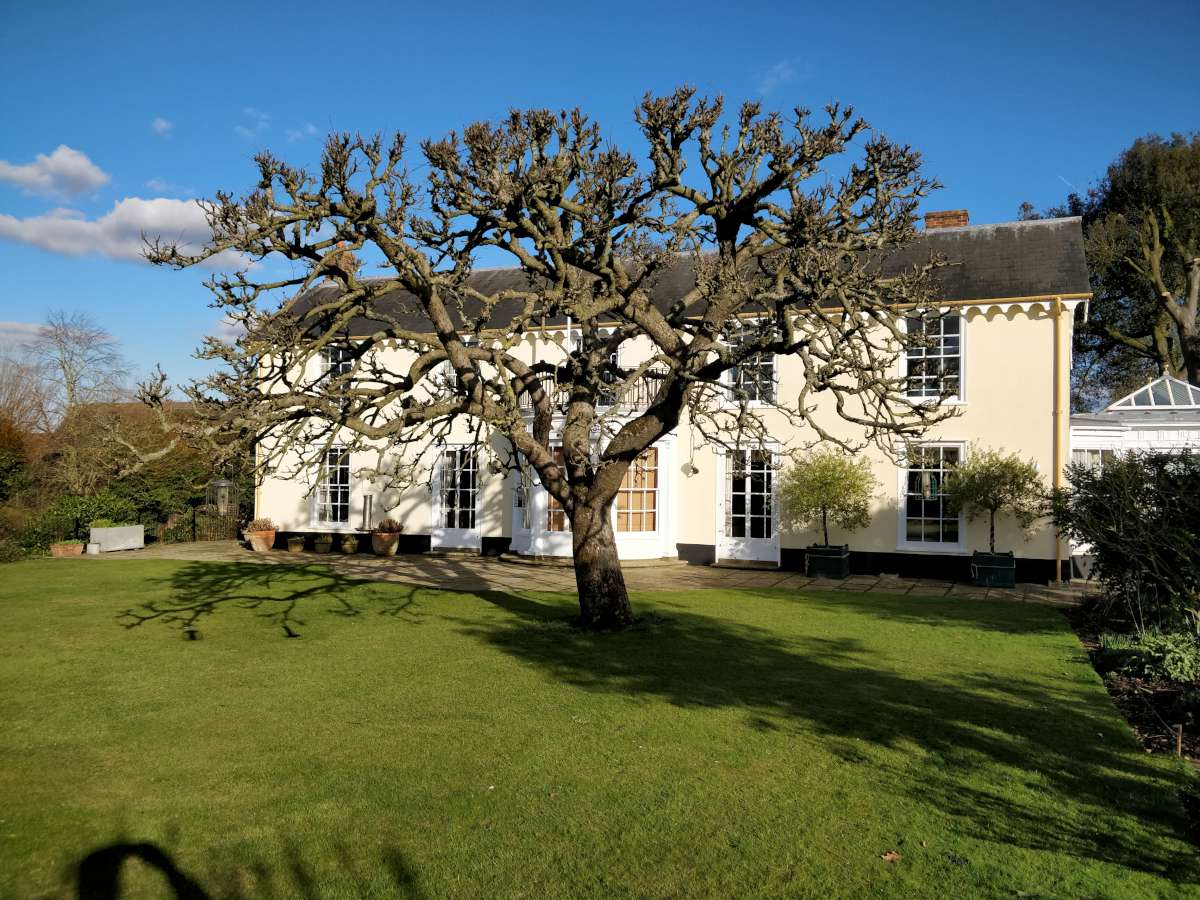
Fruit trees and the English landscape. Throughout the ages fruit trees have always formed part of the English rural and urban landscape. We are tree suppliers with a difference: we have specialist knowledge of the types and combinations of the many fruit trees available, so that we can help make your own environment dreams and ideals come true.
So many idyllic landscapes are a combination of grassy areas, meadows, animals and trees. What often is forgotten, or not given sufficient thought, is the fact that even though the landscaped, extensive country orchard seems, to the unpracticed eye, to be “at one” with nature, in actual fact some protective steps have to be taken, bearing in mind the natural urges of fox, hare, rabbit, mice, squirrels, and sometimes deer. This means foolproof fencing.
Another typical scene of rural England is the ornamental or fruiting tree enclosure, where crab apples and other fruit trees provide food, shade and shelter to all different kinds of poultry. In ecological terms this is a fascinating combination, because poultry – in particular, guinea fowl – help keep pests at bay by searching for grubs. Again, the fencing of such areas has to be fox, deer, rabbit and hare proof. (See our links page for a useful address for poultry in an orchard). When nut trees are involved, squirrels can be a real problem.
If you are looking for a virtually maintenance-free area, then the great variety of the beautiful ornamental crab apple can be given serious consideration. We stock many varieties of all sizes, shape and colours. These can be planted in combination with medlars, quinces, walnuts and sweet chestnut trees.
All this goes to show that a fruit tree is not an independent organism: it is an integral part of its habitat. Each type of fruit tree has its favourite companion, and it benefits from this “good company” by growing and cropping better, and remaining naturally healthier. Trees do a lot better, if seen as part of a whole, be it a garden, orchard, or secluded area for relaxation or meditation.
We have considerable experience of all these different situations, and we can help you with this as part of our tree supply package. In relation to your site and soil type, we can advise you about varieties and planting distances. We can advise you and supply you with all that is needed in your particular circumstances. As part of our after sales service, we continue to supply “know-how” if and when needed to all our tree purchasers.

Some of the areas covered by our fruit tree supply and consultancy service:

  • fruit trees for the patio and garden
  • small scale orchard: grow your own fruit
  • tree selection: apple trees, pear trees, plum trees, cherry trees, walnut trees, fig trees, medlars, crab apples
  • tree size: container grown trees, compact trees, cordon trees, espalier trees, dwarfing trees, vigorous trees, dwarfing rootstocks, wild trees
  • ordering trees and stakes
  • site evaluation: soil, drainage, windbreaks, frost pockets, microclimate
  • planting
  • pollination systems
  • fertilising: foliar feed, seaweed
  • pest and disease control: apple tree troubles, chlorosis, canker, tree fungus, tree pests, tree diseases, tree scab, tree mildew, weed control
  • summer pruning, winter pruning
  • growing fruit trees in pots, containers, glasshouses or polytunnels
  • integrated pest and disease control methods
  • biological pest and disease control, organic fruit growing
  • orchard renovation, fruit tree renovation
  • layout of soft fruit areas: strawberries, raspberries, loganberries, redcurrants, blackcurrants, blackberries, gooseberries, stone fruit etc.
  • fruit quality: tree fruit troubles, soft fruit troubles
  • preparing budgets for fruit projects
  • fruit storage methods
  • fruit marketing advice

Explore the website to find out more about the fruit trees we have for sale, Dan Neuteboom and Real English Fruit... or send us an e-mail!

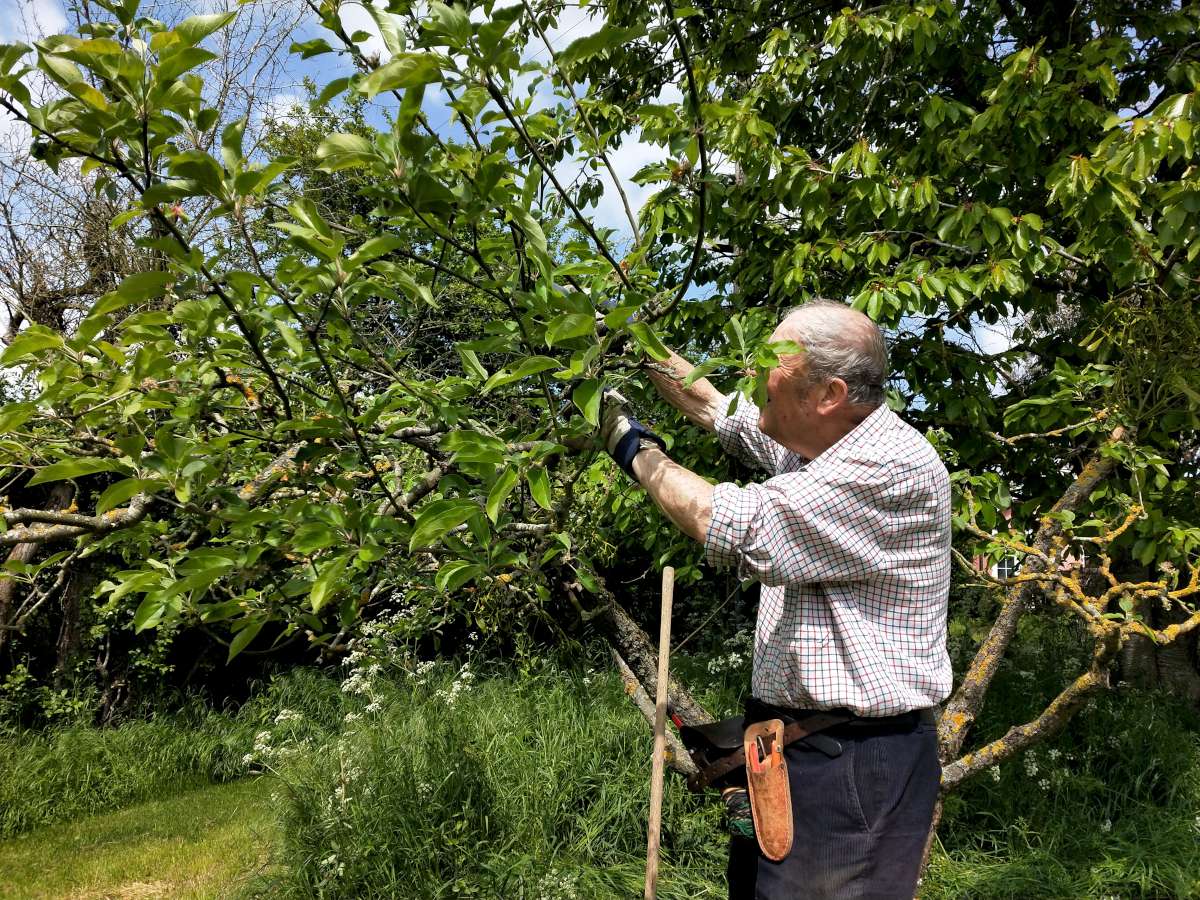
Fruit Trees for SaleBackground. Dan Neuteboom studied agriculture and qualified at the Institute of Agriculture in Dordrecht in Holland, which is now part of the University in Delft, near Rotterdam. After a forty-year career - entirely in Suffolk, UK - in the fruit business as a grower, Dan has truly become "the man who talks to trees". If you would like to plant a tree, or plan a small orchard, or if you have a tree that needs attention, Dan is the right man.
Dan Neuteboom founded Real English Fruit, based in Suffolk, UK, in order to supply quality fruit trees, for growing in pots, patios, gardens and small orchards, while also exploiting the new possibilities offered by the web to provide expert consultancy for all problems concerning home orchards. Dan and Real English Fruit are just an e-mail - or phone call.

Useful links. Click here for some useful links to some other fruit-tree and horticulture-related websites.

Click here to read Dan Neuteboom's blog

Contact us: dan.neuteboom@btconnect.com

Phone 01379 870759